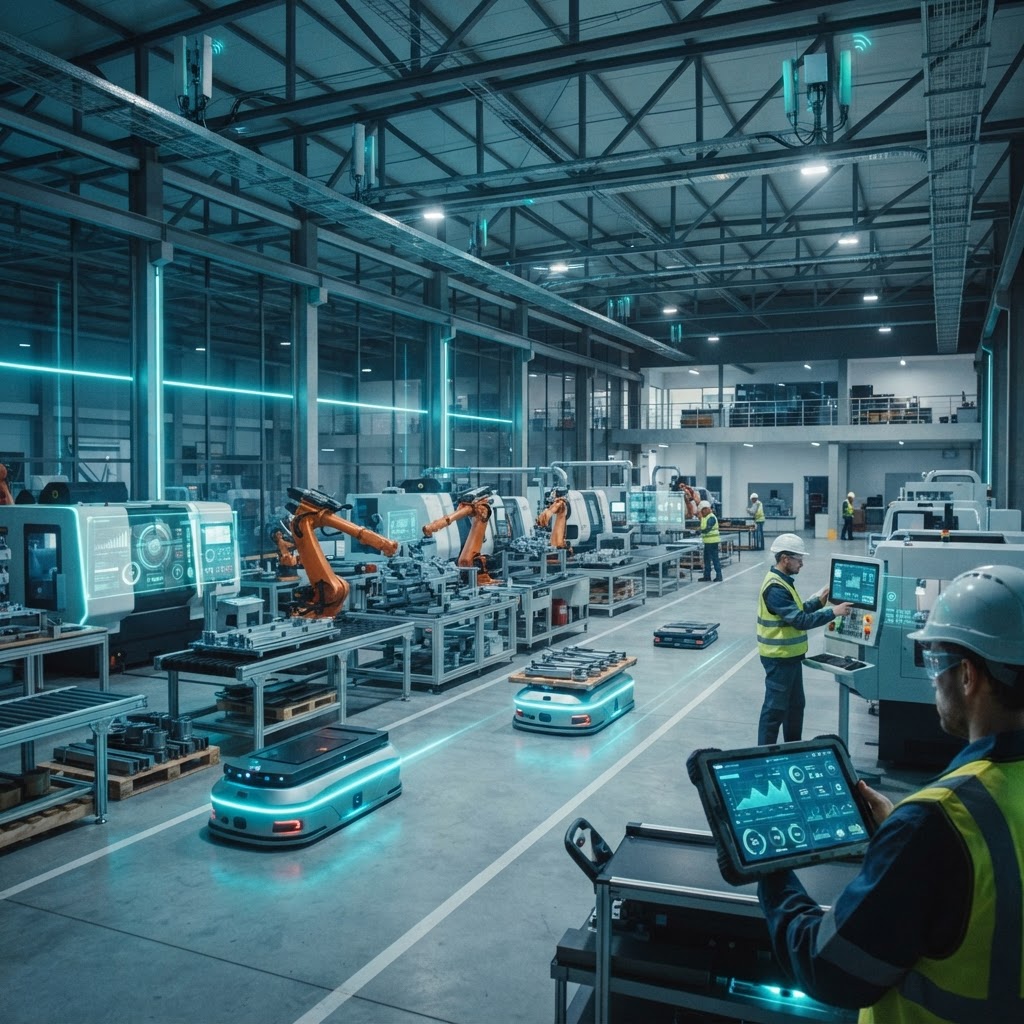
The Manufacturing Revolution
The manufacturing industry stands at the precipice of its most significant transformation yet. As we enter the era of Industry 4.0 and beyond, the need for ultra-reliable, low-latency wireless connectivity has never been more critical. Private 5G networks are emerging as the cornerstone technology enabling this transformation, offering manufacturers unprecedented control, security, and performance.
Unlike traditional Wi-Fi networks or public cellular infrastructure, Private 5G delivers guaranteed quality of service, massive device connectivity, and enterprise-grade security—all within a dedicated network that manufacturers fully control. This paradigm shift is enabling applications that were previously impossible or impractical.
Why Private 5G Matters for Manufacturing
Ultra-Low Latency for Real-Time Operations
Modern manufacturing processes demand split-second responsiveness. Collaborative robots working alongside human operators, autonomous guided vehicles (AGVs) navigating dynamic factory floors, and precision assembly operations all require latency measured in milliseconds, not seconds. Private 5G delivers latency as low as 1-5ms, enabling truly real-time control and coordination.
Consider a scenario where an AGV must react to an unexpected obstacle or a human worker entering its path. The difference between 50ms latency (typical for Wi-Fi) and 2ms latency (achievable with Private 5G) can literally be the difference between a safe stop and a collision.
Guaranteed Quality of Service
In a manufacturing environment, not all data is created equal. Emergency stop signals, robotic control commands, and safety alerts must take absolute priority over routine sensor readings or maintenance logs. Private 5G's network slicing capability allows manufacturers to create virtual networks within their physical infrastructure, each with guaranteed bandwidth and latency characteristics.
Massive Device Connectivity
A modern smart factory can have thousands—or even tens of thousands—of connected devices: sensors, actuators, cameras, robots, tablets, AR/VR headsets, and more. Private 5G can support up to 1 million devices per square kilometer, far exceeding what traditional wireless technologies can handle. This massive connectivity enables comprehensive monitoring and control across every aspect of production.
Transformative Use Cases
Predictive Maintenance
By connecting vibration sensors, thermal cameras, and acoustic monitoring equipment across production machinery, manufacturers can collect real-time data streams that feed AI-powered predictive maintenance systems. These systems can identify anomalies and predict failures days or weeks before they occur, enabling scheduled maintenance during planned downtime rather than costly emergency repairs.
The bandwidth and reliability of Private 5G means that high-frequency sensor data—previously impossible to transmit wirelessly—can now flow seamlessly to edge computing platforms for real-time analysis.
Digital Twins and Simulation
Digital twin technology creates virtual replicas of physical production lines, enabling manufacturers to simulate changes, optimize workflows, and troubleshoot issues before implementing changes in the real world. Private 5G provides the bidirectional data flow required to keep digital twins synchronized with their physical counterparts in real-time.
Augmented Reality for Maintenance and Training
AR headsets can overlay repair instructions, highlight components, and provide remote expert guidance to on-site technicians. However, AR applications demand high bandwidth for video streaming and low latency for interactive responsiveness. Private 5G's performance characteristics make AR practical for everyday use in manufacturing environments, reducing training time and improving first-time-fix rates for maintenance issues.
Security and Data Sovereignty
Manufacturing data—production rates, quality metrics, proprietary processes, and competitive intelligence—is incredibly valuable and sensitive. Private 5G keeps all data on-premises, never traversing public internet or third-party infrastructure. Combined with end-to-end encryption and enterprise authentication mechanisms, this provides security levels that public networks simply cannot match.
The Path Forward
As manufacturing continues its digital transformation journey, Private 5G is evolving from a competitive advantage to a foundational requirement. Early adopters are already seeing significant returns: 30-40% reductions in downtime, 20-30% improvements in productivity, and dramatic improvements in worker safety.
The future of manufacturing is wireless, intelligent, and autonomous. Private 5G is the wireless infrastructure that makes this future possible—today.
Conclusion
Private 5G represents more than just faster wireless connectivity—it's an enabling platform for the next generation of manufacturing innovation. From autonomous operations to predictive analytics, from digital twins to augmented reality, the applications enabled by Private 5G are transforming how products are made.
Manufacturers who embrace this technology now will be better positioned to compete in an increasingly digital, automated, and data-driven industry landscape.
By Badrinath Kodandarama