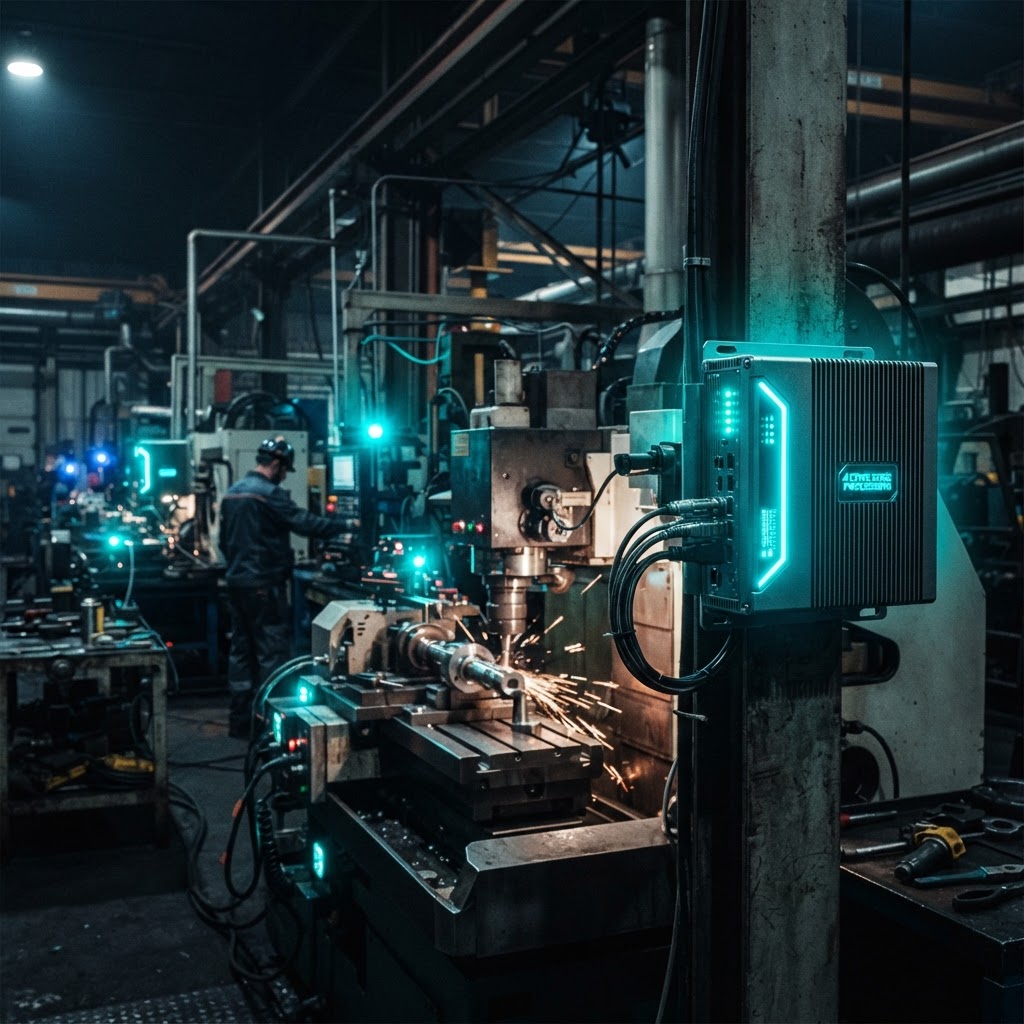
The Edge Revolution
For years, the cloud computing paradigm has dominated enterprise IT: centralize data processing in massive data centers, leverage economies of scale, and access resources on-demand. While this model has driven incredible innovation, it's reaching its limits when it comes to time-critical industrial applications.
Edge computing flips this model on its head by moving computation and data storage closer to where data is generated and where decisions must be made. Instead of sending all data to distant cloud servers, edge computing processes it locally—at the "edge" of the network.
Why Edge Matters
Latency: The Speed of Decision
Consider an autonomous vehicle navigating a factory floor. If it detects an obstacle, it needs to stop immediately—not after waiting for data to travel to a cloud server hundreds or thousands of miles away, be processed, and receive instructions back. That round-trip could take 100-200 milliseconds or more. At edge, processing happens in under 10 milliseconds.
This latency difference is transformative for applications like: robotic assembly, autonomous vehicle navigation, industrial process control, real-time quality inspection, and safety-critical monitoring systems.
Bandwidth: Moving Less, Deciding More
A modern factory might have thousands of high-resolution cameras, vibration sensors, thermal imaging systems, and other data-generating devices. Sending all this raw data to the cloud continuously would require enormous bandwidth and incur significant costs.
Edge computing enables local processing: instead of sending raw video streams, send only alerts when anomalies are detected. Instead of transmitting all sensor readings, send summaries and exception reports. This dramatically reduces bandwidth requirements while still enabling intelligent decision-making.
Reliability: Operating When Disconnected
Internet connectivity isn't always guaranteed, especially in remote locations like mines, oil fields, or offshore platforms. Edge computing enables critical operations to continue even when cloud connectivity is lost. Local edge systems can maintain operations, store data locally, and sync when connectivity is restored.
Edge AI: Intelligence at the Source
The combination of edge computing and artificial intelligence creates powerful new capabilities. AI models can run locally on edge devices, analyzing data in real-time without cloud dependency. Applications include: visual quality inspection using computer vision, predictive maintenance through vibration analysis, anomaly detection in sensor streams, natural language processing for voice commands, and facial recognition for security and access control.
The Edge-Cloud Continuum
Edge computing doesn't replace cloud—it complements it. The optimal architecture uses both: edge for time-critical processing, local control, and data filtering; cloud for long-term storage, complex analytics, and centralized dashboards. Data flows bidirectionally: real-time decisions at edge, aggregate insights in cloud.
Implementation Challenges
Edge computing introduces new complexities: managing distributed infrastructure, ensuring security across many endpoints, orchestrating updates and deployments, monitoring system health remotely, and balancing processing between edge and cloud.
Success requires thoughtful architecture, robust management tools, and operational expertise. Organizations must decide what to process where, design for intermittent connectivity, implement zero-trust security, and plan for scale from the beginning.
The Future is Distributed
As IoT devices proliferate, 5G networks enable massive connectivity, and AI models become more efficient, edge computing will become increasingly central to enterprise architecture. The future isn't centralized or distributed—it's both, with intelligence distributed where it's needed most.
Organizations embracing edge computing today are building the foundation for tomorrow's intelligent, responsive, autonomous operations.
By Badrinath Kodandarama