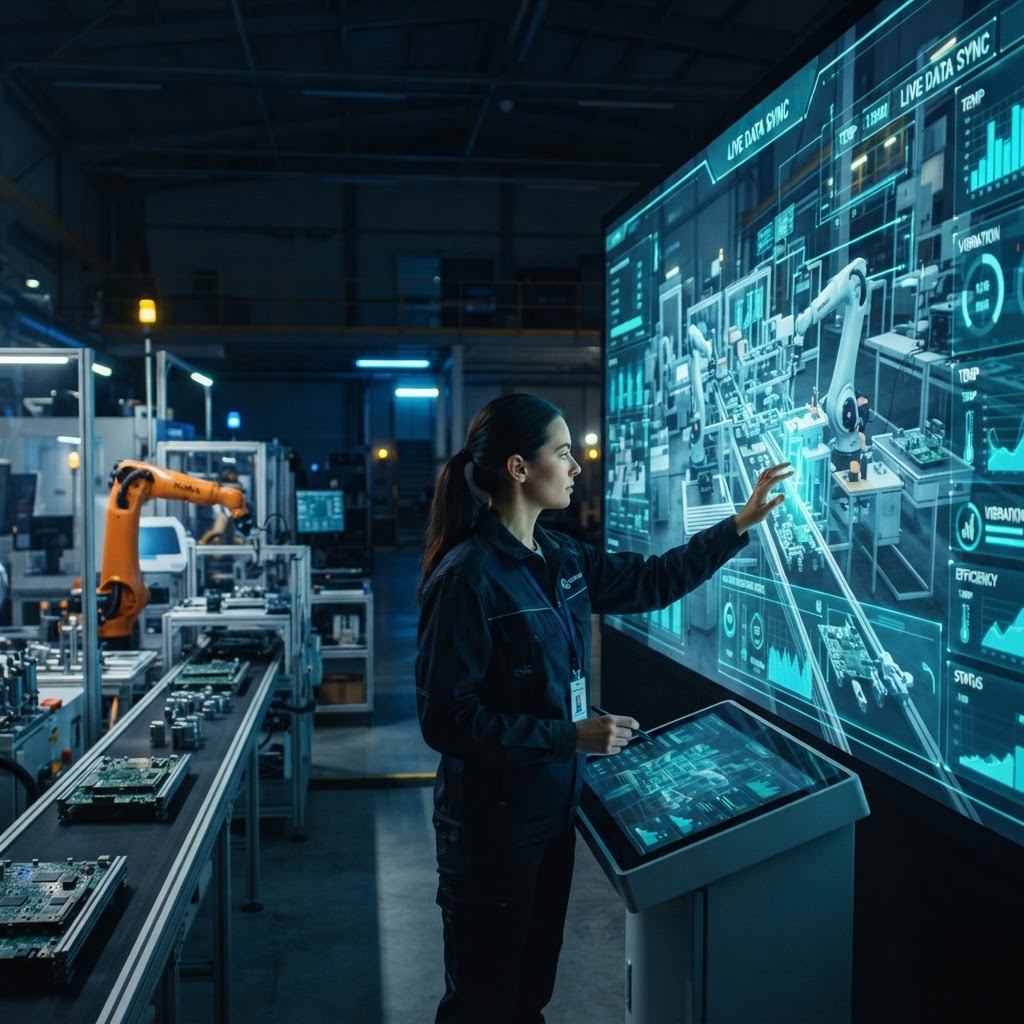
The Virtual Mirror of Reality
Imagine being able to see your entire production facility in a virtual environment, updated in real-time with data from thousands of sensors. You can zoom into individual machines, see their current status, predict when they'll need maintenance, test process changes without disrupting production, and optimize workflows before implementing them physically. This is the promise of digital twin technology.
What is a Digital Twin?
A digital twin is a virtual replica of a physical asset, process, or system. It's not just a 3D model or simulation—it's a living, breathing digital representation that mirrors its physical counterpart in real-time, fed by continuous streams of sensor data.
Digital twins exist at multiple levels: component level (individual machines), system level (production lines), and facility level (entire factories). Each level provides different insights and enables different optimizations.
Key Capabilities
Real-Time Monitoring and Visualization
Instead of walking the factory floor or checking individual dashboards, operators can see the entire operation at a glance. Temperature, pressure, vibration, throughput—all visualized in context on the digital twin. Anomalies become immediately visible, and operators can drill down for details.
Predictive Maintenance
By comparing current machine behavior against historical patterns and physics-based models, digital twins can predict failures before they occur. A slight change in vibration pattern, a gradual temperature increase, or declining efficiency—all can be early warning signs that the digital twin detects and flags for attention.
What-If Scenario Testing
Want to change production sequencing? Add a new product line? Modify workflows? Test it in the digital twin first. See how changes will impact throughput, identify bottlenecks, optimize resource allocation—all without disrupting actual production.
Training and Simulation
New operators can learn on the digital twin, making mistakes and seeing consequences without real-world costs. Maintenance teams can practice complex procedures. Engineers can validate designs before building physical prototypes.
Enabling Technologies
Digital twins require several technologies working together: IoT sensors for real-time data collection, 5G/Private networks for reliable connectivity, edge computing for local processing, cloud platforms for storage and analytics, AI/ML for pattern recognition and prediction, and 3D visualization for human interaction.
Real-World Impact
Manufacturers implementing digital twins are seeing 20-30% reductions in maintenance costs, 15-25% improvements in asset utilization, 10-20% increases in throughput, and faster time-to-market for new products. Beyond metrics, digital twins fundamentally change how organizations understand and optimize their operations.
Implementation Journey
Start with high-value assets or critical processes. Build the digital twin incrementally, adding detail and sophistication over time. Focus on specific use cases with clear ROI. Ensure data quality and connectivity. Train teams on new ways of working.
Digital twin technology represents a fundamental shift in manufacturing—from reactive to predictive, from physical to hybrid, from siloed to integrated. Organizations embracing this technology are building the intelligent, adaptive factories of the future.
By Badrinath Kodandarama