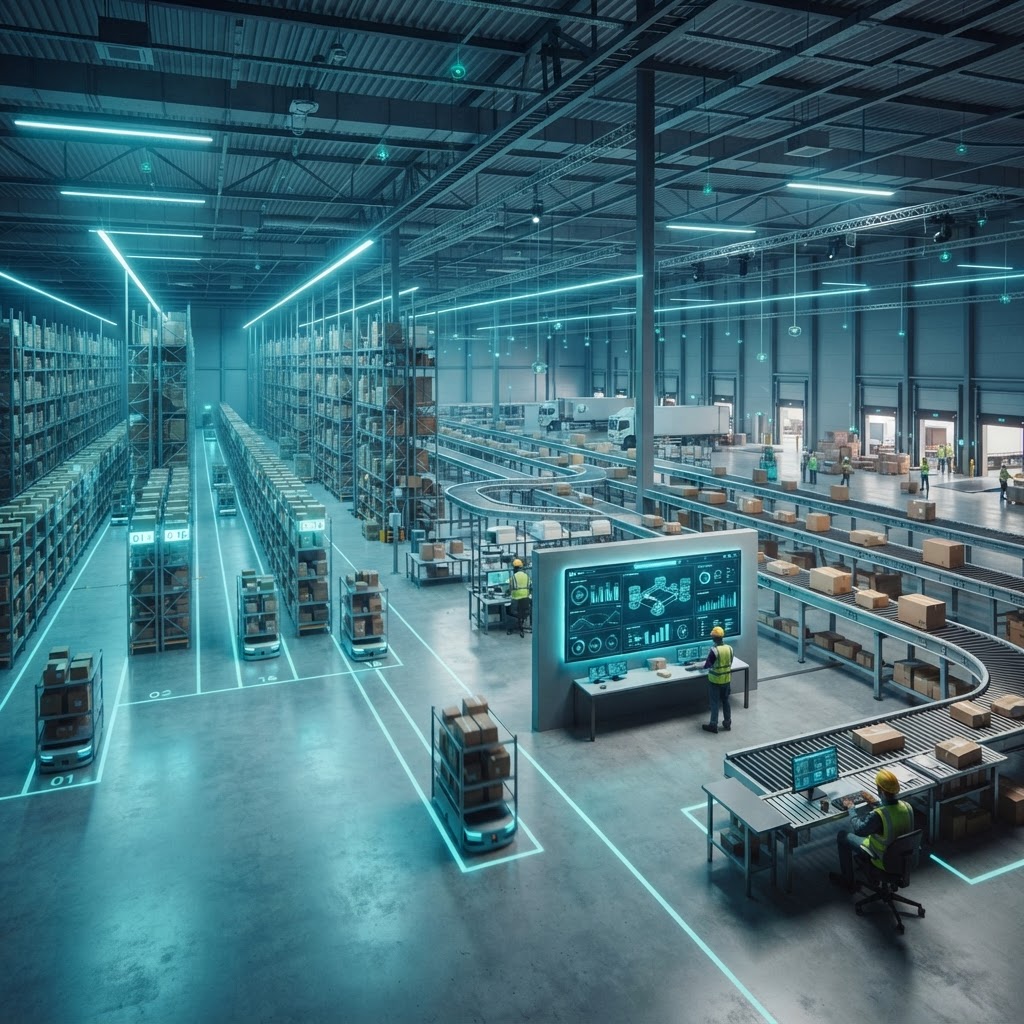
The Warehouse Revolution
E-commerce has transformed consumer expectations: same-day delivery, real-time tracking, perfect order accuracy. Meeting these demands requires warehouses to operate with unprecedented speed, accuracy, and efficiency. Smart warehouse technology—combining automation, IoT, and intelligent software—is making this possible.
Today's smart warehouses bear little resemblance to traditional facilities. Autonomous robots navigate aisles, AI optimizes inventory placement, IoT sensors track every item's location, and predictive analytics forecast demand. This transformation is delivering dramatic results: 75% faster order fulfillment, 99.9% inventory accuracy, 50% reduction in labor costs, and 3x capacity increase without facility expansion.
Core Technologies
Autonomous Mobile Robots (AMRs)
Unlike traditional conveyor systems or fixed automation, AMRs navigate dynamically using onboard sensors and mapping technology. They transport inventory, assist pickers, and move pallets—all without fixed infrastructure. AMRs coordinate with each other and human workers, adapting routes in real-time to avoid congestion and optimize efficiency.
Modern AMRs use SLAM (Simultaneous Localization and Mapping) technology, computer vision, and AI-powered path planning. They can operate in dynamic environments, handle varying payloads, and even work in mixed fleets with different robot types coordinating seamlessly.
Automated Guided Vehicles (AGVs)
AGVs follow predefined paths using magnetic strips, wires, or laser guidance. While less flexible than AMRs, they excel at repetitive, high-volume material movement along fixed routes. AGVs are ideal for moving goods between receiving, storage, picking, and shipping zones on consistent, predictable paths.
IoT-Based Inventory Tracking
RFID tags, BLE beacons, and IoT sensors provide real-time visibility of every item's location, movement, and status. Smart shelves detect when items are picked or restocked. Environmental sensors monitor temperature and humidity for sensitive goods. This granular visibility eliminates inventory discrepancies and enables perfect order accuracy.
Warehouse Management Systems (WMS)
Modern WMS platforms orchestrate all warehouse activities using AI and machine learning. They optimize putaway strategies, direct picking routes, allocate resources dynamically, predict demand, and coordinate human workers with automated systems. Cloud-based WMS platforms enable real-time visibility across multi-warehouse networks.
Advanced Capabilities
Goods-to-Person (GTP) Systems
Instead of workers walking to pick items, automated systems bring products to stationary picking stations. This eliminates unproductive travel time, increases picking rates by 2-3x, reduces errors, and minimizes worker fatigue. Robots retrieve storage bins, present them to pickers, and return them automatically.
AI-Powered Slotting Optimization
AI analyzes order patterns, product velocity, and seasonal trends to optimize where items are stored. Fast-moving items are placed in easily accessible locations. Products frequently ordered together are stored nearby. Seasonal adjustments happen automatically. This optimization can reduce picking time by 30-40%.
Predictive Demand Forecasting
Machine learning models analyze historical data, market trends, weather patterns, and external signals to predict demand. Warehouses can pre-position inventory, optimize staffing levels, and coordinate with suppliers—all before orders arrive. This predictive capability reduces stockouts while minimizing excess inventory.
Augmented Reality for Picking
AR glasses overlay picking instructions, highlight target items, display optimal paths, and provide real-time guidance. New workers achieve experienced picker productivity in days instead of weeks. Error rates drop dramatically as AR systems verify picks before allowing workers to proceed.
Connectivity: The Nervous System
All these technologies depend on robust, reliable wireless connectivity. Private 5G networks are emerging as the ideal infrastructure for smart warehouses, providing guaranteed latency for robot coordination, massive device connectivity for IoT sensors, dedicated bandwidth for AR systems, and network slicing for different application priorities.
Implementation Considerations
Smart warehouse transformation typically happens in phases: start with high-impact areas like receiving or picking; deploy proven technologies before custom solutions; ensure strong change management and worker training; integrate new systems with existing WMS and ERP; measure results and iterate based on data.
Human-Robot Collaboration
Smart warehouses aren't about eliminating workers—they're about amplifying human capabilities. Robots handle repetitive, physically demanding tasks. Humans focus on problem-solving, quality control, exception handling, and continuous improvement. The most successful implementations thoughtfully design this collaboration, creating safer, more satisfying jobs while improving productivity.
The Future of Warehousing
As technologies mature and costs decrease, smart warehouse capabilities will become standard, not exceptional. Fully autonomous dark warehouses operating 24/7 without lighting are already reality for some operations. Micro-fulfillment centers embedded in urban areas bring inventory closer to consumers. Drone-based inventory management and delivery will handle high-value items.
The warehouse of tomorrow will be intelligent, autonomous, and intimately connected to the broader supply chain ecosystem. Organizations investing in smart warehouse technology today are building the foundation for the on-demand, customer-centric logistics networks of the future.
By Badrinath Kodandarama