Smart Campus: Private 5G Transforming Education & Research
How private 5G networks enable immersive learning, advanced research, smart infrastructure, and connected campus experiences for the universities of tomorrow.
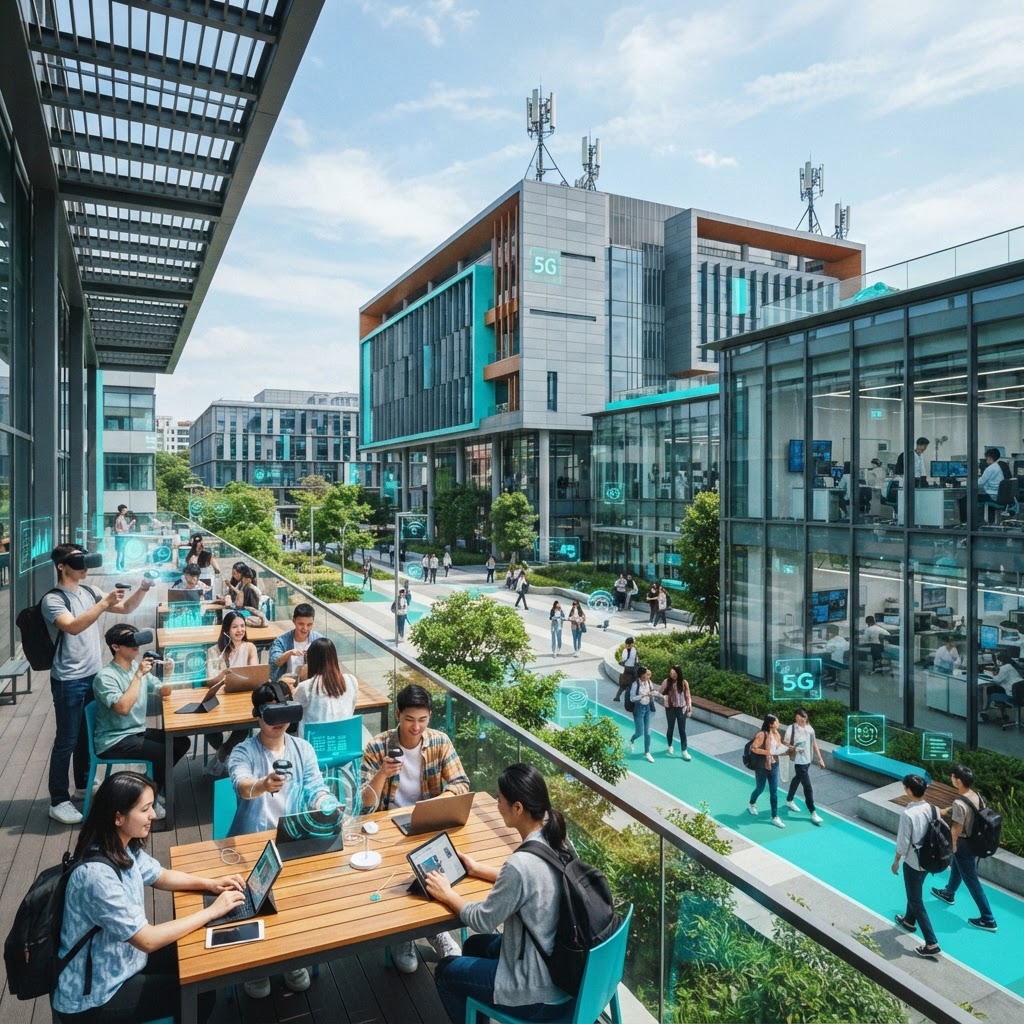
The Campus Connectivity Challenge
Modern universities face unprecedented connectivity demands: thousands of students streaming lectures, researchers running data-intensive experiments, smart building systems optimizing energy use, and security systems protecting vast campuses. Traditional Wi-Fi struggles with capacity, coverage, and quality of service. Private 5G provides a transformative solution.
Why Private 5G for Campuses?
- Campus-Wide Coverage: Seamless connectivity indoors, outdoors, and across large areas
- High Capacity: Support for tens of thousands of simultaneous users and devices
- Network Slicing: Dedicated resources for research, learning, and administrative operations
- Low Latency: Real-time applications for AR/VR learning and research collaboration
- Data Sovereignty: Complete control over sensitive research and student data
- IoT Support: Connectivity for smart buildings, environmental sensors, and campus operations
Transforming the Learning Experience
Immersive & Interactive Learning
Private 5G enables AR/VR applications that transform education. Medical students perform virtual surgeries with haptic feedback. Engineering students interact with 3D models of complex machinery. History students walk through virtual reconstructions of ancient civilizations. The high bandwidth and low latency of 5G make these experiences seamless and engaging.
Hybrid & Remote Learning
5G-enabled cameras and microphones create immersive hybrid classrooms where remote students feel present. Multi-angle video streams, real-time transcription, and AI-powered translation break down barriers of distance and language. Students worldwide can participate in world-class education.
Advancing Research & Innovation
5G Research Testbeds
Universities deploy private 5G networks as living laboratories. Researchers experiment with edge computing, network slicing, AI/ML algorithms, and IoT applications in real-world environments. Students gain hands-on experience with cutting-edge technology while contributing to advancements in telecommunications and connected systems.
Collaborative Research
High-bandwidth 5G connectivity enables real-time collaboration across campuses and with global partners. Researchers share large datasets, control remote instruments, and conduct joint experiments as if they were in the same lab. This breaks down geographical barriers and accelerates scientific discovery.
Advanced Simulation & Digital Twins
Engineering and science programs use 5G-connected sensors to create digital twins of physical systems — from HVAC systems to chemical processes. Students run simulations, test hypotheses, and learn from failures in safe virtual environments before working with physical equipment.
Smart Infrastructure Management
Energy Optimization
IoT sensors throughout campus buildings monitor occupancy, temperature, lighting, and equipment status. AI algorithms optimize HVAC, lighting, and energy systems in real-time, reducing costs by 20-30% while improving comfort. Universities report significant progress toward carbon-neutral operations.
Predictive Maintenance
Sensors on elevators, HVAC systems, plumbing, and electrical equipment predict failures before they occur. Maintenance teams receive alerts and work orders automatically, preventing disruptions to campus operations and extending equipment lifespan.
Campus Safety & Security
AI-powered video analytics detect unusual behavior, unauthorized access, and safety hazards across campus. Emergency alert systems use 5G to send location-specific notifications to students and staff. In emergencies, first responders access real-time building information, camera feeds, and indoor positioning data.
Wearable panic buttons and blue-light phones connected via 5G provide immediate assistance. Geofencing ensures alerts reach people in affected areas while avoiding unnecessary panic elsewhere.
Connected Campus Services
Smart Parking & Transportation
Sensors detect available parking spaces, guiding drivers via mobile apps to reduce congestion and frustration. Autonomous shuttles provide last-mile connectivity across large campuses, while real-time transit information helps students plan their commutes efficiently.
Personalized Student Services
Mobile apps connected via 5G provide personalized campus navigation, event notifications, dining hall wait times, library room availability, and academic support resources. Students access everything they need through a unified digital experience.
Global Collaboration & Cross-Campus Integration
Universities with multiple campuses use private 5G to create unified experiences. Students participate in classes across campuses, share library resources, and collaborate on projects as if physical distance didn't exist. This breaks down silos and creates richer educational ecosystems.
The Business Case
Universities deploying private 5G report:
- 20-30% reduction in energy costs through smart building optimization
- Improved student satisfaction and engagement through enhanced learning experiences
- Attraction of top researchers through world-class infrastructure
- New revenue from 5G research partnerships and testbed access
- Competitive advantage in student recruitment
Building the Campus of Tomorrow
As education evolves, universities must provide connectivity that supports innovation, research, and student success. Private 5G networks transform campuses into living laboratories where students learn with cutting-edge technology, researchers push boundaries, and institutions operate sustainably and efficiently.
Written by
Vortenix Technology Team