Autonomous Vehicles & Connected Mobility: The 5G Enabler
How private 5G networks enable autonomous vehicle fleets, V2X communication, and intelligent transportation systems in industrial and campus environments.
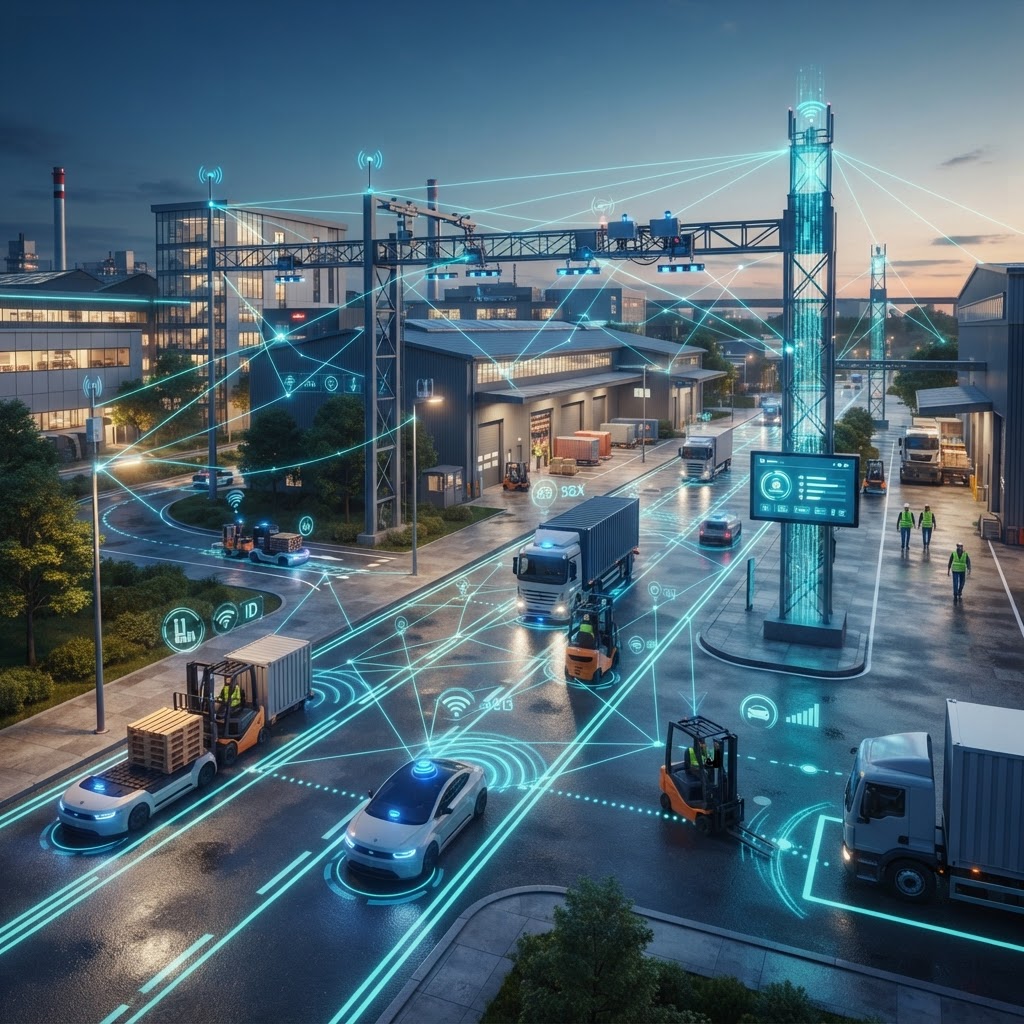
The Autonomous Mobility Revolution
While fully autonomous vehicles on public roads remain years away, closed industrial environments like factories, warehouses, ports, and campuses are already deploying autonomous vehicle fleets at scale. Private 5G networks provide the ultra-reliable, low-latency connectivity these systems require.
Why 5G for Autonomous Vehicles?
- Ultra-Low Latency: Sub-10ms response times for real-time decision making
- High Reliability: 99.999% availability for safety-critical operations
- High Bandwidth: Support for HD sensor data, video streams, and map updates
- Network Slicing: Guaranteed bandwidth for vehicle control vs. passenger services
- Edge Computing: Local processing for immediate response to dynamic conditions
- V2X Communication: Vehicle-to-everything connectivity for coordinated operations
Key Applications
1. Autonomous Material Handling
AGVs (Automated Guided Vehicles) and AMRs (Autonomous Mobile Robots) transport materials, parts, and finished goods across factories and warehouses. 5G enables dynamic path planning, real-time obstacle avoidance, and fleet coordination. Unlike fixed-path systems, 5G-connected AMRs can adapt to changing layouts and production demands.
2. Vehicle-to-Everything (V2X) Communication
5G enables vehicles to communicate with each other (V2V), infrastructure (V2I), pedestrians (V2P), and central systems (V2N). This cooperative awareness improves safety, enables platooning for fuel efficiency, and optimizes traffic flow across industrial sites and campuses.
3. Remote Vehicle Operation
When autonomous systems encounter edge cases or complex scenarios, human teleoperators can take control remotely. Low-latency 5G connectivity delivers multiple HD video streams and sensor data to operators who can guide vehicles through challenging situations, then return control to the autonomous system.
4. Fleet Management & Optimization
Central fleet management systems use real-time data from all vehicles to optimize routes, balance workloads, predict maintenance needs, and coordinate charging/refueling schedules. AI algorithms continuously improve efficiency based on historical patterns and current conditions.
5. Enhanced Safety Systems
Beyond onboard sensors, 5G-connected vehicles receive real-time alerts about hazards detected by other vehicles or infrastructure sensors. Geofencing prevents vehicles from entering restricted areas, while proximity detection protects workers in mixed human-robot environments.
Edge Computing for Real-Time Intelligence
Autonomous vehicles generate massive amounts of sensor data — lidar, radar, cameras, and ultrasonic sensors producing gigabytes per second. Private 5G networks with edge computing enable local processing of this data, reducing latency and bandwidth requirements while improving response times.
Edge servers can run AI models for object detection, path planning, and decision-making, with only high-level commands and critical data transmitted to central systems.
Use Cases Across Industries
Manufacturing
Autonomous forklifts and tuggers move materials between production lines, warehouses, and loading docks. Just-in-time delivery of parts reduces inventory costs while maintaining production flow.
Logistics & Warehousing
Fleets of AMRs transport goods in e-commerce fulfillment centers, coordinating with automated storage and retrieval systems (AS/RS) to maximize throughput during peak periods.
Airports
Autonomous baggage tugs, catering vehicles, and passenger shuttles operate airside, improving efficiency while reducing emissions and labor costs.
Smart Campuses
Autonomous shuttles provide last-mile connectivity across university and corporate campuses, while delivery robots transport mail, packages, and food to buildings.
Security & Safety
Private 5G networks provide end-to-end encryption and network isolation, preventing unauthorized access to vehicle control systems. Unlike public networks, operators maintain complete control over their infrastructure, reducing cyber-attack surfaces and ensuring compliance with safety standards.
The Path to Deployment
Organizations deploying autonomous vehicle fleets should:
- Start with defined use cases in controlled environments
- Deploy private 5G infrastructure with edge computing capabilities
- Establish robust safety protocols and redundancy systems
- Plan for human-in-the-loop oversight and remote operation capabilities
- Implement continuous monitoring and improvement processes
The Future of Mobility
As autonomous technology matures and 5G networks expand, we'll see increasing deployment of autonomous vehicles in industrial settings. These systems will become more intelligent, efficient, and capable — transforming how goods and people move within enterprises while improving safety, productivity, and sustainability.
Written by
Vortenix Technology Team