From Reactive to Predictive
For decades, industrial maintenance has followed two models: reactive maintenance (fix it when it breaks) and preventive maintenance (service it on a schedule). Both approaches have significant drawbacks. Reactive maintenance leads to unexpected downtime and costly emergency repairs. Preventive maintenance often services equipment that doesn't need it while missing equipment that does.
Predictive maintenance, powered by artificial intelligence, offers a fundamentally better approach: maintain equipment based on its actual condition and predicted failure patterns. This shift from scheduled to condition-based maintenance can reduce maintenance costs by 25-30%, eliminate 70-75% of breakdowns, and reduce downtime by 35-45%.
How AI-Powered Predictive Maintenance Works
Data Collection
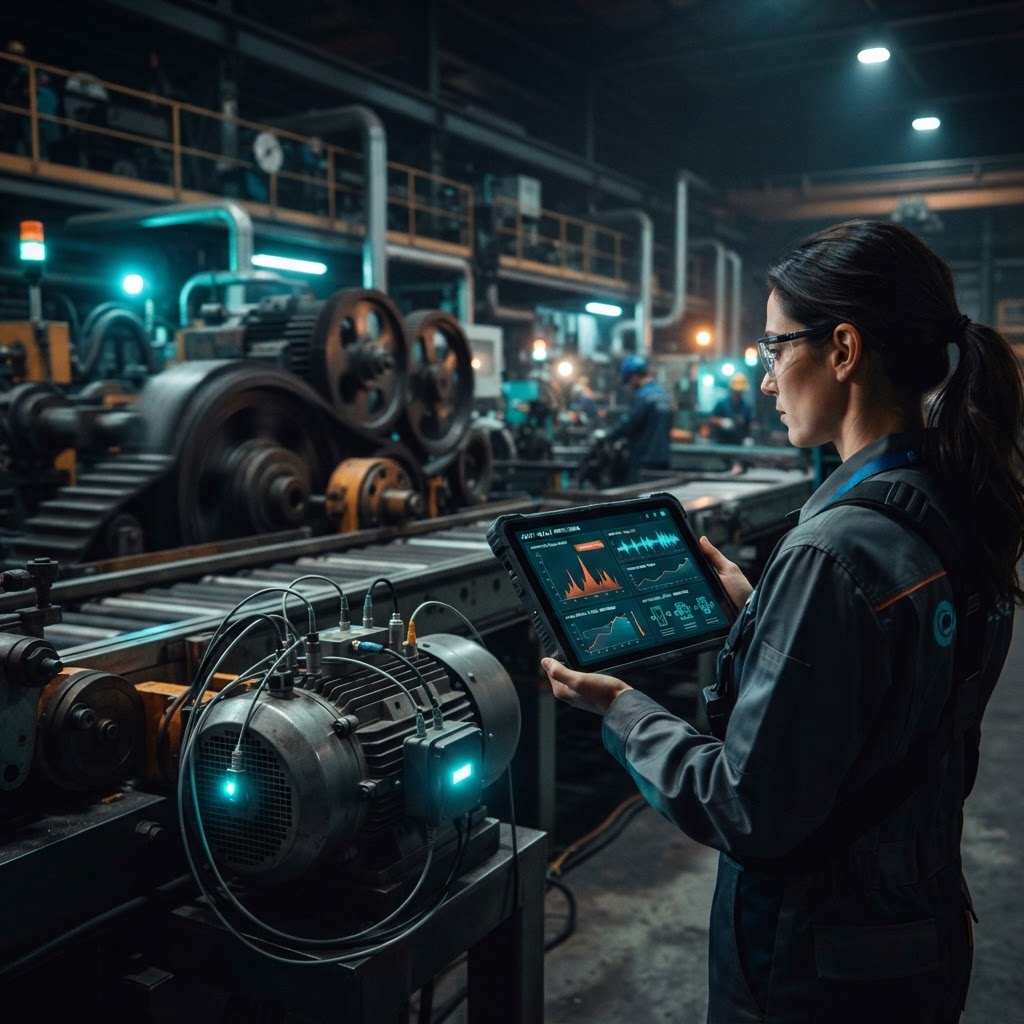
The foundation of predictive maintenance is comprehensive data collection. Modern industrial equipment is instrumented with sensors measuring vibration, temperature, pressure, acoustic emissions, electrical current, oil quality, and operational parameters. These sensors generate continuous streams of data that AI systems analyze for patterns and anomalies.
Pattern Recognition
AI excels at identifying patterns in complex, multi-dimensional data. Machine learning models are trained on historical data showing how equipment behaves before failure. They learn to recognize subtle changes—a slight increase in vibration frequency, a gradual temperature rise, changes in acoustic signature—that precede failures by days or weeks.
Anomaly Detection
Beyond known failure patterns, AI systems can detect anomalies—deviations from normal behavior that may indicate emerging problems. Unsupervised learning algorithms establish baselines for normal operation and flag unusual patterns that warrant investigation, even if they don't match known failure modes.
Failure Prediction
Using historical failure data and current operational conditions, AI models predict when equipment is likely to fail. These predictions include failure probability, predicted time to failure, failure mode, and recommended actions. This enables maintenance teams to schedule interventions during planned downtime, order parts in advance, and allocate resources efficiently.
AI Techniques in Predictive Maintenance
Machine Learning Classification
Classification algorithms categorize equipment condition: normal, warning, critical. Random forests, support vector machines, and neural networks learn from labeled historical data to classify current conditions accurately.
Deep Learning for Complex Patterns
Deep neural networks excel at identifying complex patterns in high-dimensional data like vibration spectra or acoustic signatures. Convolutional neural networks can analyze sensor data as "images" to detect subtle patterns invisible to traditional analysis.
Time Series Analysis
LSTM (Long Short-Term Memory) networks and other recurrent neural architectures model temporal dependencies in sensor data. They understand not just current values but trends and patterns over time, crucial for predicting degradation.
Ensemble Methods
Combining multiple AI models often yields better results than any single approach. Ensemble methods aggregate predictions from diverse models to improve accuracy and reliability.
Real-World Applications
Rotating Equipment
Motors, pumps, compressors, and turbines generate characteristic vibration and acoustic patterns. AI analyzes these signatures to detect bearing wear, imbalance, misalignment, and other issues weeks before failure.
HVAC Systems
AI monitors energy consumption, temperature differentials, pressure, and performance metrics to predict compressor failures, detect refrigerant leaks, and optimize efficiency.
Production Lines
Manufacturing equipment degradation affects product quality before causing complete failure. AI detects these early quality signals and predicts when adjustments or maintenance are needed.
Implementation Best Practices
Start with high-value, critical assets where failures are most costly. Ensure comprehensive, high-quality sensor data. Clean and label historical data for model training. Begin with simpler models before progressing to deep learning. Validate predictions against actual failures to improve accuracy. Integrate predictions into maintenance workflows and work order systems. Continuously retrain models as new data becomes available.
Challenges and Considerations
AI predictive maintenance requires significant upfront investment in sensors and infrastructure. Models need substantial historical data including failure examples. Results can be difficult to interpret—understanding why AI predicts a failure matters for maintenance planning. Integration with existing maintenance systems and workflows takes planning and effort.
The Future of Maintenance
As AI capabilities advance, predictive maintenance will become increasingly sophisticated. Self-learning systems will continuously improve predictions. Integration with digital twins will enable "what-if" scenario analysis. Autonomous maintenance systems may even schedule and execute routine maintenance with minimal human intervention.
The shift to AI-powered predictive maintenance represents a fundamental transformation in how industrial operations manage assets. Organizations embracing this technology are achieving unprecedented reliability, efficiency, and cost savings—turning maintenance from a necessary cost center into a strategic advantage.
By Badrinath Kodandarama